Not too long ago, I put up a simple little video on my YouTube channel.
It was just me showcasing a bunch of different skipping variations with a nice tune bumpin’ in the background.
Nothing special.
Well, in less than 7 months, the video has been viewed over 70 thousand times! (I still can’t believe so many people want to watch me skip…kinda cool!) And it seems like they genuinely liked it because the video has over 650 likes.
But more important than anything, the video has sparked some interest. Hundreds of comments and questions were posted under the video (see here) with people looking to get started with skipping. Mission accomplished.
I noticed, however, that a lot of the same questions kept coming up. A lot of people didn’t know where to get started. So, with all this wisdom brewing up in my head (separate from the ego), I thought it would only make sense to put together an in-depth post to answer every single question (and then some) that was asked. Due to its level of detail, the post is a little lengthy (sorry), but it’s jam-packed with useful information. You’ll find everything you need to know about skipping rope.
I have appropriately named it the Jump Rope Manifesto.
I hope you guys find it useful.
Let’s get started…
The Benefits of Skipping Rope
I spoke before about how effective skipping can be. Think about it – with only one simple (and cheap) tool and just a little bit of space, you have absolutely everything you need to construct a very powerful workout.
In terms of bang for your buck, skipping is an extremely efficient form of training. Your entire body is engaged from repetition to repetition. You are engaging your calves, hamstrings, core, shoulders and arms while simultaneously strengthening your most vital organ – your heart.
When jumping rope, you are improving your balance, coordination, and overall sense of awareness. You are training your speed, agility, and explosiveness. You are developing mental toughness and the ability to focus even when under stress. You are building a skill set and developing a fitness level that will transfer well into any and all activities you choose to pursue in life.
The benefits of skipping rope are endless and are completely worth the effort of learning how to use this powerful tool.
Is Skipping Rope Better than Running?
This was a question that came up frequently and it’s a difficult one to answer because it depends on a number of factors.
Number one would be your intensity. Skipping at a high intensity will yield better results on average than jogging at a light, consistent pace. But skipping will never out-do sprint training.
Second would be your preference. A lot of people hate running. They’re bored of it. So they don’t do it. Skipping is a great alternative for cardiovascular exercise and if you add some variation to your movements it can keep you motivated to a greater degree.
My suggestion would be to alternate between the two. That way you will get all the benefits and you’ll never be bored.
Should I Jump Rope with Ankle Weights?
I get this question a lot.
I think too many people have this misconception that jumping rope with ankle weights is more efficient than regular skipping.
The truth is that jumping rope on its own has incredible benefits. You can get everything you need from this tool without having to strap on extra weight to your legs.
I don’t have a lot of experience with ankle weights. I’ve tried them a couple of times, didn’t like them and ended up scrapping them for good. Some jumpers claim that ankle weights can cause issues with the joints, while others say they’ve become lighter on their feet.
My recommendation is to avoid any and all ‘extra weights’ (ankle weights, weighted vests, etc.) until you become proficient with jumping rope. If you really want to make things challenging, start using heavy ropes.
Do you do a warm up before skipping?
Short answer is yes.
But, generally speaking, skipping is my warm up. I typically spend 3-5 minutes jumping rope at a very light pace. Nothing too intense or too explosive. I focus on a few minutes of light skipping where I alternate between different variations (see below).
Once I’m done with that, I’ll typically do some mobility exercises for my ankles, knees, and hips before I get into my more intense training (whether it be heavy rope training or double under work).
This is the same typical warm up I’d use for all of my training.
Can I Lose Weight by Skipping Rope?
This was probably the most common question asked on my channel. People want to know whether you can lose weight with by only using a jump rope.
The short answer is yes.
But there’s more to it than that. You see, one of the well known benefits of skipping rope is its calorie-burning effects, as I’ve mentioned in my previous post. Researches say that one hour of skipping rope (at a moderate pace) can help you burn over 1,000 calories. That comes out to roughly 20 calories per minute!
But whether you ‘lose weight’ or not is not determined by your training, but by your nutrition strategy. After all, you can’t out-train a bad diet.
So can you lose weight? Absolutely. But would I recommend you only skip? Probably not. Although you would still get results, they would not parallel to the results you would get if you combined your skipping routine with an effective weight training routine and a well-polished eating plan. But I’ll save those details for a future post.
Getting Started with Skipping Rope
The fact of the matter is that skipping rope takes time to learn. It takes practice. It requires great overall coordination and timing. On top of that it demands excellent cardiovascular fitness and mental focus.
With that being said, when you’re first starting out, you want to make things as easy as you can for yourself. This includes fitting yourself with the right style and length of rope.
Types of Skipping Ropes
One of the common questions I’ve been asked is what type of rope I use. Here’s the thing. Jump ropes are like candy bars (bad comparison, I know). They come in all shapes, sizes, colours, and lengths. There is an unlimited range of choices.
Here is a list of some of the most common types of skipping ropes you’ll see:
- Fabric Jump Rope - also known as ‘braided’ or ‘cotton’ jump ropes, these are the simplest of the bunch. They are super cheap and are usually made of either cotton or nylon cords, which are then braided (giving them their name). These ropes rotate very slowly as they create a lot of drag. They may or may not come with handles. This is for the ultimate beginner. Be aware that you will outgrow this type of rope very quickly.
- Beaded Jump Rope – these ropes are made of plastic beads that are strung on a piece of thin nylon. These are very common in competitions due to their high visibility and beautiful array of patterns that are created when they turn at fast speeds. These ropes are also super cheap and last long on rough surfaces. They have a very loud clanking sound when they hit the ground so they can be useful for improving your timing (I’ll explain later). If you’re looking for this type of rope, make sure the handles are of high quality.
- Leather Jump Rope – these are classic ropes that have been used by boxers for generations. They are not for beginners. The ‘rope’ is basically a strip of leather attached to either plastic or wooden handles. They are heavier than fabric jump ropes and they turn faster than both fabric and beaded ropes. A few drawbacks: if you mess up, be ready for pain (just imagine getting whipped by leather-ouch!); if it gets wet, it will shrink (change length essentially); they are prone to twisting. This rope is awesome but it’s definitely more for advanced skippers.
- Plastic (Speed) Jump Rope – also known as speed ropes, these ropes are very popular. They’re typically made of PVC and are very light and inexpensive. They keep their shape very well and don’t tend to twist up. The thickness of the rope can vary, but they are all pretty long lasting (unless you keep them in the sun often). You can pick up very good speed with these ropes which, in combination with their low price, makes them very popular.
- Weighted Jump Rope – weighted ropes are designed to give you a better upper body workout. From my experience, they’re really effective for building grip strength. Weighted ropes come in two types: either the handles are weighted or the rope itself is weighted. Most weighted ropes have a thick plastic-coated cable and can weigh up to 5lbs. A word of warning: if you mess up, you’ll get a beating. These ropes are only recommended for advanced skippers and are the most expensive of the bunch.
- Wire Jump Rope – also known as cable jump ropes, these are designed for pure speed enthusiasts. The rope is a piece of wire and you can generate some crazy speed with thing. It’s the most durable rope and also the most painful. They are not very expensive but are only recommended for hardcore jumpers.
You can see that there are many types to choose from. I own a number of these, but that’s because I love this stuff!
If you’re a beginner, you don’t need anything more than a simple plastic (PVC) speed rope to get started. You can get this rope for super cheap from any general fitness store. I would avoid fabric and beaded jump ropes as most beginners quickly outgrow them.
As you get better and you want to invest in a higher quality rope, you can look into something like the Buddy Lee Jump Rope.
I currently use a jump rope system called the CrossRope. It’s an interchangeable system of jump ropes that allows me to work with both speed and heavy ropes. If you’re interested in learning more about these, I put together a nice review of the jump rope system.
When choosing your rope, there’s one thing that you really need to pay attention to…
The Design of the Handle
The handle itself can be of varying lengths, thicknesses, weights and shapes. Which one you choose really depends on your personal preference.
For example, long handles are better for freestyle skipping (utilizing a lot of arm movements), thicker handles provide better grip, weighted handles engage the forearms more, and different shapes cater to easier handling. It all comes down to preference. If you can, try out a few different styles and see what works for you.
The most important thing to look at is how the handle is connected to the rope. You want to choose a rope that allows the cable to spin freely within the handles as you skip. If the cable cannot spin freely, it will start to twist up and make life extremely difficult.
There are many designs out there. The most common design comes with cheaper plastic ropes and is a simple washer connected to the end of the rope that can spin freely inside the handle. These work well but do not last very long if the rope is used frequently.
Some ropes use simple triangular hooks. These are common for cloth ropes connected to wooden handles. However, I have seen them on other ropes. I would avoid cloth ropes in general, but the hook system seems to work well.
A lot of modern ropes now utilize ball bearings for the connection. These ball bearings are typically built inside the handle (making them slightly heavier), although some utilize a ball bearing and swivel system. Ball bearings, in general, create smooth rotations of the rope as you skip. Some people think ball bearing designs are garbage because they tend to stick, but I haven’t had any problems with them. They last much longer than the simple washer connection, but they do come at a higher price.
My recommendations: with advancements in technology, there are a lot of unique innovations in this area. If you’re just starting out, a simple plastic skipping rope with a decent washer system is good enough. However, as you get better and skip for longer periods at a time, you’ll want to move to a ball bearing system (or other higher quality connection).
Picking the Right Length of Rope
This is also another very common question that came up. How do you pick the right size of rope for your body?
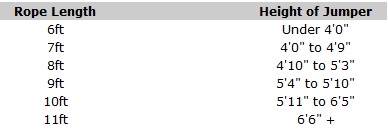
Finding the right length of rope is very important. If the rope is too long or too short, you’ll be forced to change up your mechanics to avoid constantly tripping yourself up. Ropes that are too short force you to keep your arms too low and allow very little room for error. Ropes that are too long make skipping difficult because the rope hits the ground too far in front of your body causing it to catch your heels.
Both situations suck, so to minimize frustration and improve your skipping efficiency, it’s imperative that you find a rope that is the perfect length for you.
Here are some general guidelines for rope sizing (reference):

Note that these are just general guidelines. The final length of your rope will usually depend on where you hold your rope as you skip. You’ll probably want to start with the rope size recommended in the chart, then try it out and make necessary modifications.
I like to use the follow steps to ensure that I have the right length of rope:
- Stand with your feet shoulder-width apart,
- Put the rope underneath one foot and pull the handles up to your chest,
- The ends of the rope (not the handles) should be roughly at the level of your nipples/base of your chest.
Here’s a video that quickly outlines this process:
You can see that it’s easy to make simple modifications to your rope if it’s too long.
As you become more proficient with jumping rope, you can play around with different lengths of rope. For example, I like to use shorter ropes when I’m doing double unders because I can turn the rope faster. But, naturally, this provides very little room for error.
Choose your Surface Wisely
If you’ve ever played tennis before, you’ll know that you need to adjust your game depending on the surface that you play on. Same thing goes when you’re skipping rope. You’ll have to adjust your mechanics a bit depending on your surface of choice. Different surfaces will cause the rope to bounce and slide differently, so if you don’t make the proper adjustments, you’ll make more mistakes. Also, harder surfaces will have a greater impact on your joints than softer surfaces. These are all things you have to take into consideration.
The best surface to skip rope on is a wooden floor (such as in a gymnasium). They’re soft enough for your joints and offer great bounce for your rope if you’re interested in picking up momentum and even pulling off a few multiple unders.
If a gymnasium is not at your disposal, look for gyms that have rubber padding. These are also great for your joints and offer good bounce for your rope. If you got some money to spare, you can get your own rubber padding and build a little section at home that you can skip on [here's an example].
Carpets are also great for your joints, but they are much bouncier so you’ll have to get up a little higher on each jump to avoid the rope catching your heels.
The one surface I would avoid at all costs is concrete. It’s very hard on your joints and it will tear your rope into pieces. Plus it’s hardness will result in greater buildup of fatigue, meaning you won’t be able to skip for long periods.
Proper Jump Rope Technique
There is a right way and a wrong way to jump rope. Here are some short guidelines to follow to help keep you on track:
- Jump on the balls of your feet
- Keep your knees slightly bent
- Keep your jumps to 1/4 to 1/2 inch off the ground
- Keep your elbows close to your sides
- Use your wrists to turn the rope, not your arms
- Keep your head straight and looking forward
- Keep your upper body relaxed, not tense
- Focus on keeping your shoulder blades retracted
- Control your breathing
These are the basic guidelines you need to follow and they are very dependent on you choosing the right length of rope. When you first start off, you’ll have the tendency to jump really high, kick your heels back and make huge swings with your arms. That’s fine. But you’ll want to work your way towards smaller hops and less arm movement. Note that as you get better, some of these guidelines do get broken for specific variations. But it’s very important that you master the basic jump rope technique before you move onto anything else.
How to Improve Your Timing
With skipping, timing is everything. Your brain is required to make extremely quick calculations to to recognize the skipping rope’s distance, direction, speed, and position. All of this comes down to timing.
The one thing that makes skipping so difficult is that there is a lot of work that is required up front to master the technique and build up the necessary timing and coordination. When you have poor technique, or poor timing and coordination, you tend to trip up a lot. And for those who have tried skipping before, you’ll know how frustrating (and sometimes painful) this can be. This is what causes a lot of people to quit.
But I have a little trick that can help you overcome that.
Start off by holding both handles in one hand, with the rope to your side. Begin swinging the rope on that one side (kind of like a helicopter). Make sure you let the rope hit the ground on each revolution so that you can hear the rope making contact (remember how I said the beaded ropes work well for this).
Now, the objective is to try to hop every single time the rope makes contact with the ground.
At first, it will seem like the most awkward thing in the world. But, the reason why it works is that you can’t trip up. By listening to the rope hitting the ground and trying to time your hops to match, you’ll slowly begin to improve your timing, coordination and overall feel for the skipping rope without having to deal with the frustrations of tripping up.
If you’re new to skipping, start off with this slowly. You don’t need to swing the rope quickly, just at a pace you can match with your hops. Then pick up the pace as you progress. Once you feel like you got the timing down, try proper skipping. You should feel a big difference.
Adding Variation (once you get good)
This is invariably where most of you started as this is exactly what the original video is all about. This is what made me famous! (just kidding)
Once you get fairly good at skipping, you’ll want to add some variation to keep things fresh. Adding variation to your routine eliminates the boredom that comes with repetitive movements. It keeps skipping fun and challenging.
Here’s the video I made that highlights 23 skipping rope exercises you can incorporate into your routine. (Note: if it doesn’t load, please refresh the page and it will magically appear)
Choose two or three of these variations and start implementing them into your routine.
A Simple Skipping Workout
The beautiful thing about skipping is that you’re only limited by your creativity. As I mentioned earlier, all that you need is a rope and a little bit of space and you have everything at your disposal for putting together a great workout.
Just to give you an example, I’ve put together a simple little skipping workout to show you exactly what I’m talking about. This is as simple as it gets (it’s simple in theory, tough to actually do). Watch the video below.
Note: if it doesn’t load, please refresh the page and it will magically appear.
As you can see, the workout itself is short but intense. You can utilize any of the jump rope variations I showed earlier to construct numerous workouts like this.
As you get better, you can mix up your jump rope training with other forms of training like kettlebells, bodyweight exercises, etc. The possibilities are endless. For example, here’s a video of a CrossFit workout I did called “Annie”.
Note: if it doesn’t load, please refresh the page and it will appear.
Update
I’ve recently put together a full-blown jump rope training program to teach you how to become a jump rope master and build a better body in the process.
If you’re interested, check out:
Jump Rope Ninja: Build a Better Body with a Jump Rope
Final Words
Man, that’s a lot of skipping information to consume. But I hope you can see just how effective this simple little tool can be.
If you haven’t picked up a skipping rope yet, it’s time to add this baby to your toolbox. It’s cheap, it’s portable, it’s reliable, and, most importantly…
It’s POWERFUL.
I hope you guys found the Jump Rope Manifesto useful. My goal was to give you everything you needed (information wise) to get started with skipping. If you found this useful, please do me a favor and share it with others. I would really appreciate it!
What are your thoughts on skipping rope? Is it part of your routine? Will it become a part of your routine now that you see how easy and effective it can be? Share your wonderful comments below!


My name is Srdjan. I am a trainer, an engineer, and (hmmm) an extreme experimentalist. Follow my journey to a better body or take a second to find out what Bloom to Fit is
Srdjan,
Great post. This is enough information for anyone new to skipping to get started. I actually had no idea there were so many different kinds of ropes! Congrats also on the success with the video!
Alykhan
Thanks Alykhan, that was the idea
I’m hoping this post, coupled with the video will be enough to motivate people to get started with skipping. It’s too much to skip out on (sorry for the terrible pun lol).
Srdjan, I also get tons a questions about getting started with a jump rope and your manifesto is a great resource. I can’t wait to share it.
-Mitchell
I’m glad skipping has picked up in popularity. It definitely deserves its share of mentions. Thanks for sharing it buddy! I appreciate that.
Srdjan,
I’ve been skipping rope for almost a year and a half and, since I found your website, I’ve followed your guidelines and tips to improve my training (I found about HIIT thanks to you, and since then, my routines changed a lot). But his manifesto has made my day; maybe my year. I’ll definitely add the workout your shared to my routines, and I’ll try to buy a more advavanced rope.
Congrats and thanks a lot!
Francisco, I’m really excited to hear that you found use in this! Let me know if you have any questions along the way. I’d be more than happy to help
I really couldn’t tell you, I never even knew there were different types for begginers and advanced skippers. I only found out by accident when I went online to find my old rope. When I first bought my boxer’s rope I didn’t even own a laptop then. I would have thought a rope is a rope, just different kinds, and trial & error, finding the best one suited to yourself.
It’s really great that you have spiced up skipping, it’s such a cheap easy effective way for both sexes to keep fit.
Well done for highlighting SKIPPING as a MUST DO EXERCISE to include in your exercise routine, especially for lots of us who can’t afford the GYM.
You can even bring your rope on holiday with you as it’s small and lightweight, so there’s no excuse for missing out on exercise. If you take your rope with you, the extra food and drink you will probably consume can be litterally skipped off, (just skip harder)
Keep up the good work. Tania
Thanks for your comment Tania. I’m glad you found the post useful. There’s so much about skipping that people don’t know. My only hope is to highlight those areas and possibly spark some interest in people. Once people realize how powerful (and enjoyable) it is, they’ll jump on board (pun possibly intended).
can u write on hw to do double unders?
id also like to see how to skip while seated on the floor…thats really awesome
I can definitely put together a video to show you how to do a double under. But the seated one I’ll have to learn myself first
Very comprehensive review of jumping rope and great videos. Between this post and your other posts, you could probably throw together a nice e-book on the topic if you ever wanted to. In the meantime, thanks for the great tips!
Thanks for the comment Dave. I’ve thought about that for some time, but for now I think I’ll just keep giving away as much as I can. I’m glad you enjoyed the content!
I have a concrete drive way that I was going to jump rope on but you said to avoid concrete. It’s the only place big enough that I can use anytime because I have a newborn so I can’t drag him around to gyms. Could I put a big rug down on the concrete and jump on that and it be alright? By the way thank you much for posting this. I heard about jump roping so I have been researching alot about it and still had many questions but your website answered everything. Your advice help ALOT and saved me alot of wasted time sitting in front of the computer trying to find answers so I can start working out sooner. Very much appreciated! P.S. I absolutely love the music you use in your videos. Gets me anxious to start working out. Where do i find it?
Hey Jayme! I’m really happy that you found the manifesto useful. I got some more skipping related content coming so stay tuned!
As for your question, I definitely understand where you’re coming from. A lot of people have the same issue. As I mentioned in the post, the best option would be to get a few pieces of rubber padding (not very expensive) that you can set up on your driveway. If this isn’t an option, then try looking for a soft gravel path. If there are none around, you can try skipping on grass (although the ground would have to be somewhat harder). Skipping on a rug on the concrete (unless it’s a super thick one) would save your skipping rope, but wouldn’t do much to protect your joints. But try things out. See what feels good for you.
PS – I use sites like stereomood.com to listen to a lot of random music until I find something I like. Then I dive deeper into an artist or group I like. A lot of people have been asking me for playlists so I might put a quick one together and send it out to you guys.
amazing! i really love this manifesto. It is very detailed and offers up a lot of good information all in one place so you don’t need to go looking around anymore. I definitely did not know that there were so many ways to skip rope let alone different skipping ropes. I found your website from your 23 ways video and the video is really good. Thank you.
P.S. I think its really sweet that you want to share the information that you know just to help people. Never Stop.
I’m really glad you found it useful! And don’t worry I don’t plan on stopping
I was wondering if you could help me with a skipping problem I have: For every time my skipping rope makes a circuit, I jump twice. I tried that coordination trick you wrote about, and I’ve tried other ways like going faster or slower or trying to control my hand movements, but nothing works. This jumping twice action really hinders me and makes it very difficult to do more than 20. Have you ever encountered something like this before? Do you possibly have any advice for me on how to stop it? I would really appreciate your help.
Thanks,
Paz
Hey Paz, the double jump between rotations is a common ‘problem’ (if it’s a problem at all). That’s how we all started. I think at the point you’re at the issue seems more mental than anything. I’ve seen it with a lot of people where they just can’t get away from jumping twice. This is what you can try. For a little while, throw away the rope. Put it aside. What you’re going to do is skip without the rope. Pretend that you’re holding the handles of a rope and skip. What you want to do now is time the rotations of your wrists with your hops so that every time your feet touch the ground your wrists make one full revolution and are pointing down to the ground. It will feel really awkward at first but after a little while you’ll get it. Practice this and then get the rope back into action. The same principles apply. Your wrist should be pointed down every time your feet touch the ground. It will take some time but give it a chance and you’ll be pleasantly surprised.
Let me know how it goes. If it doesn’t work I got some other things you can try!
I just found everything that I needed. This explanation is perfect and your video too. Gives a lot of information for those who want to start or even for those who already skip and wants to get better, like me. I’ve skipping for year and would like to know more about different types of ropes, and which one would be more helpful to improve my technique and my variations too. Thank you very much, Srdjan.
Happy to help Eduardo! Let me know if you have any specific questions along the way.
I’m really in the beggining of my skiping life and this manfesto helped me a lot, thank you!
No problem!
Thank you so much!! I found this very helpful. I will feature this in my blog if u don’t mind
thank you again.
I’m happy you liked it! And of course I don’t mind!
Whao what a great manifesto, super happy to have stumbled across it today!! I was looking for some help as tonight is the night that my rope and I get reacquainted! And speaking of ropes, who would have thought there were so many to choose from! So, along with my running and gym sessions I hope to mix it up with some skipping and this is just the b@mb! Burn calories burn!!
Signing up for the updates too. And great website in general Srdjan. Nice abs too.
Thanks!
Lisa
Thanks for all the kind words Lisa! I’m happy you’ve found it useful. Let me know how your ‘re-acquaintance’ goes
I like it very much and youtube video is so nice, now i am also trying to follow it.
Good luck!
you’ve inspired me.gonna get started from 2moro…wish me luck
Kill it!
I’ve fallen in love w/jump rope again for the past month and my heart sank when I read your “concrete” comment. I’ve been foolishly telling myself those pains I’m feeling in my shins and ankles are the good, toughening kind but you’re right, concrete must be avoided! I just prefer my backyard to the gym or park (gas prices, lol). Thanks for the advice!
Concrete is tough on the ankle joint! Get yourself one of those rubbery mats and put it in your backyard. It’s cheaper than gas
Thank you so much for the information and instruction, Srdjan. I’ve been wanting to jump for many years now and actually bought the ropes but never did anything with them. I wasn’t sure which length, what kind or how heavy in order for me to have a safe workout. I’m all about the safety issue. Now that I’ve found your site and have a new (proper) rope I’m ready to begin. You explain things really well and I want you to know that I appreciate you. Take care.
Pam
I’m happy you found the guide useful Pam! Let me know how your skipping goes!
Hi there! I liked the video, and have a question, you’re suggesting that we should control breathing, how would you describe that to one who does not know how to do that? Do we breathe through the nose, mouth? Is there a pattern?! Sorry for the silly question, I’m kinda new to all this.
Thanks, and well done on the posts they’re very helpful
Hey Samantha! Breathing can seem a little tricky, but it’s not so bad. I prefer to inhale through my nose and exhale through my mouth (like our body is designed to do). The control part is all about rhythm. Try to keep your breaths going at a consistent pace (you don’t want to be inhaling and exhaling all over the place). The goal is to maximize your oxygen intake with fewer breaths. So the patterns really come down to personal preference. I hope that clarifies things a bit.
I’m 65 and I’ve been jumping since I was 55. I just do free-form jumping to music which ends up taking me through all the moves I need, and I keep adding to them as I get stronger and more agile – I call it JumpRock. I’m in the best shape of my life and still improving due to jumping and because I added weight training about a year ago; but my blog is primarily about how to deliberately start a daily workout habit when you find that difficult or impossible to do through self-discipline.
Back to jumping, which is my passion, my youtube site is http://www.youtube.com/qfeguy. I post videos of my most recent “workout” at https://www.youtube.com/playlist?list=PLDC3736EB0A3CFA79&feature=plcp
Also, I used the Buddy Lee magic speed rope for years, but a few years ago I found one that I think is just as good and is a lot cheaper. I’ll send the link on request.
For 65 you look like you’re in awesome shape Richard! I checked out your vids and you got some cool ideas with the jump rope. Keep up the awesome work.
Please send over the link to the rope you’re using. I always like to try out new ones!
Here’s the link:
http://www.buyjumpropes.net/Long_Handle_Freestyle_Jump_Rope_p/018%20long%20handle%20freestyle%20jump.htm. It’s $8.95 for one but cheaper if you buy in volume.
It’s also available on Amazon, but they show the normal price as the ‘sale’ price, so you may want to check both for the best price.
Thanks for the link Richard. I’ll pick myself up one of these.
As a local truck driver working 12 hour days 5 days a week with borderline high blood pressure I tried to find some way to exercise as the doc recommended. I had just about given up when I ran across your video and it inspired me so much I ran out and bought a cheap plastic rope the same day. The portability made it the perfect tool for me. I had tried diet without exercise to lose weight but failed several times. This time my plan was to forget about dieting and concentrate only on my jumping skills and let the chips fall where they may. Every day on my lunch break I would jump as many sets as I could in 30 minutes. After a little research I bought a heavy rope and cable speed rope and alternated sets with them. I bought a small roll up rubber mat to jump on to save on wear and tear on my ropes. What a combo! What eventually happened was my appetite was naturally suppressed after working out for lunch, I ate lighter and lighter to the point of eating mostly fruits and vegetables. As my skills got better my diet just seemed to change with it. After 7 months I am 50 lbs lighter with totally normal blood pressure. The customers I see every day are totally amazed at my transformation, along with my wife, kids and neighbors. I tried motivation but discipline worked for me. I jumped no matter what. If it was raining outside I jumped inside of my 48 foot trailer(which works perfectly). If I felt like crap I forced myself to jump anyway and always felt great after. I watch your video every few weeks and try something different. I crank it up on my bose speakers and the kids love it. I hope you stay with it. Thanks a lot for your help. Look forward to more.
Aaron – it’s comments like these that truly motivate me to continue doing what I’m doing. I’m so happy that my video has inspired you to make such an incredible change in your life. You should be really proud of yourself and your results. You’ve shown that even a small tool like a skipping rope is powerful enough to build a better body. Your actions will undoubtedly inspire those around you. And that’s exactly what we need to do.
I’ll definitely be staying with it. I got some great new content and videos on the way. Stay tuned!
PS – I’ve never skipped in the back of a trailer. I’ll have to give that a try
Hey! I found your blog and this guide combined with your awesome demonstrations of all the different ways you can jump made me start jumping. I’m happy to say that i’ve improved in the last week and have the ability to start using it as a fitness routine.
However, I find that the day after or at the end of the day that I performed my workout, my left achillis tendon is sore. I find it wierd that only one hurts.. Any ideias Srdjan? I normally skip about 15 minutes varying through multiple styles. How do you stretch so that you don’t get these pains?
Thank you and once again congrats on the article and the whole site!
Hey André! Nice to see you making some improvements in such a short amount of time. It’s normal to feel soreness and aches in your muscles (ex: calves) and tendons like your Achilles when you first start out with skipping. These are connective tissues that are not necessarily used to being stressed. As you progress with your skipping, you’ll notice the aches and pains disappearing.
I always stretch after my skipping workouts, particularly my calf muscles. I use this stretch [link] a lot. Nice long stretches (20-30 seconds each leg) work great. Try it out and let me know how it goes.
Hope that helps!
Thank you for an informative video and website
When skipping rope do you have any recommendations on foot wear?
Footwear is more so a personal choice. I know a lot of people that skip barefoot. Personally, I love skipping in my Vibrams. I get the protection I need while still keeping my toes involved in the action. I also like skipping in typical boxing shoes, modern runners like the Nike Frees, or even old school chucks (not as comfortable).
Remember that, in terms of protecting your joints (and your rope), the more important factor is the surface that you’re skipping on.
I just started skipping rope and love it, but after reading your article (which is great by the way), I’m worried because I don’t have any surfaces besides concrete to skip on.
I’m young and agile but is this a big no-no? I can’t even really afford rubber matting at the moment but I really want to practice skipping every day and I only have access to the gym a few times a week.
Great videos by the way!
BLC – My recommendation stands: avoid concrete. Look for short-cut, hard grass. Dirt pathways. Hardwood floors. Any of these are MUCH better than concrete. You can even find old carpet somewhere and layer them together for a softer surface. Be creative!
Hi! Love your website! It’s probably the only fitness site that is soley dedicated to jumping rope. I have been working a full-time job for the past 3 years and I have gained about 12 pounds because of sedentary sitting. I’m not obese but I think my body shape can definitely be better. I am planning on losing 10 pounds by jumping rope.
However, I’m finding it tough to find posts or people discussing their progress and weight loss results from their rope jumping. I love reading stories like Aaron’s (June 16th comment); I find it really motivating to hear detailed stories about how people’s bodies changed because of this amazing activity. It would definitely motivate me more.
I’ve always been pretty good at jumping rope but I have only began recently to use it as my main workout routine. I don’t get a lot of time in the day to exercise and 15-20 minutes a day of skipping is great for me in terms of time for cardio.
Any stories that you can share that you’ve seen or heard about fat/weight loss and how long it can take someone to lose extra body fat by jumping rope?
Also, I have only started jumping rope for prolonged periods and I find that the front of my foot / toes hurt after jumping for a while! Is this normal?? Any stretches that you can recommend for the toes or feet joints?
Thanks again and keep up the amazing work!
Hi!
I’ve been at my jump rope routine for a week straight now and feeling great! I think I actually lost 1 lb! Very excited to see my own progress.
There is one problem that I’ve always had though. My knuckles are bruising! It always happens on my left hand and never on my right. Do you have advice about how to prevent this? I’m not sure if it’s my technique or something else. I am using a ball-bearing PVC rope and I’m not sure if it’s just the delicacy of hands that make the bruisng happen when it hits my hands when I trip up or if there is a proper way to hold the rope in my hands. I’ve been holding it with my thumb on the handle with my palms facing up.
Thanks for sharing your expertise!
Jo – congrats on the awesome progress!
I’ll be honest I’ve never heard of anybody getting their knuckles bruised while skipping. It must have something to do with the way you’re holding the handles if the bruising is consistently in the same spot. I usually wrap my entire hand around the rope with my thumbs resting on my index fingers and my palms facing towards each other. Try manipulating how you hold the rope to see if there are any changes. Let me know!
I’ll see what I can do in putting together some stories or profiles for you of people that have done some great things with the skipping rope (there are a lot of them out there). I think it could definitely be a great motivational tool.
The pain in your foot is normal when skipping for prolonged periods. Make sure you’re skipping on a soft surface and you’re wearing solid protective footwear. You can also incorporate some static stretches for your calves. Otherwise, just take it slow. If it hurts, stop. But as you progress with your jump rope training you’ll notice the pain going away.
You were right about the foot pains. Since that comment on July 3rd, I’ve been jumping more often and I no longer have the foot ‘pains.’ I think it’s definitely important to wear cross-trainers or cushioned shoes when jumping. I’ve seen people do it with just socks and I have no idea how they keep up like that! As for the knuckles, I’m going to pay more attention to how I am holding the rope to see if anything changes. Maybe I’ll wear gloves if I can’t figure it out! =P
LOL if you wear gloves when doing it video tape it and send it to me
And you should give Vibrams a try one day. You’ll be pleasantly surprised.
Ok I was thinking about making a video for you but changed my mind. Only because it was the weirdest sight: I was jumping to Michael Jackson’s Beat It with one glove on my left hand….! LOL (it wasn’t white though…)
About halfway into my workout I ended up taking the glove off only because I didn’t like the gripless feeling in one hand when holding the rope.
I will definitely be looking out for a jump rope motivational guide by you! Adding success stories from jumprope and also tips and advice. I’ve got one for you: http://www.jog.fm. This is the most exciting tool I found this week for jump rope. If you don’t know it already, after someone finds the precise jump per minute rate for their jumping, they can look up their favourite songs to help them jump to their routine. I think I am graduating from 15 to 20 mins of jumping now because of this tool!! (Glad ‘Beat It’ falls into my jump/minute rate).
Thanks again!
That’s a really cool online tool. It seems like it’s dedicated to runners but it seems like it could work well for skipping too. I’ll get the app and try it out.
That sounds like an awesome video idea!! Please consider finishing it. I’d love to see it